Appearance
Architecture
A typical app that uses the VirtualC64 core consists of two kinds of threads:
- The user threads are the threads of the front-end. They call the API functions. Any thread except the emulator thread is a user thread.
- The emulator thread is created by launch(). It lives as long as the emulator object and computes frames and audio samples.
The threads never touch each other's data directly. Requests that change the state of the emulator are handed over through a command queue and carried out by the emulator thread. The emulator reports events back through a message queue.
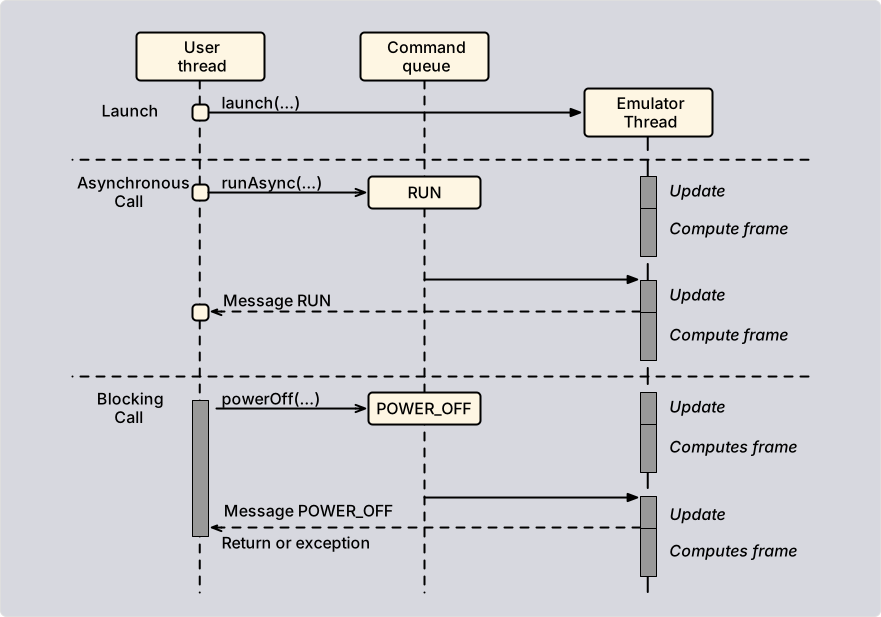
The diagram shows the three situations a front-end deals with:
- Launch. Calling launch() creates the emulator thread and registers the message callback. The callback is the only code of the front-end that runs on the emulator thread. It must not call back into the API, but forward the message to a user thread.
- Asynchronous call. Functions with an
Asyncsuffix, such as runAsync(), put a command into the queue and return at once. The emulator thread picks it up at the start of its next update cycle, so a state change never happens in the middle of a frame. The outcome arrives later as a message. - Blocking call. Functions without a suffix, such as powerOff(), queue the same command, but wait until it has been carried out. They return the outcome directly, or throw an exception. Functions that send a message will do so for blocking calls, too.
Reading the state of the emulator does not involve the queue. Getters such as isRunning() read the data directly, on the calling thread.